
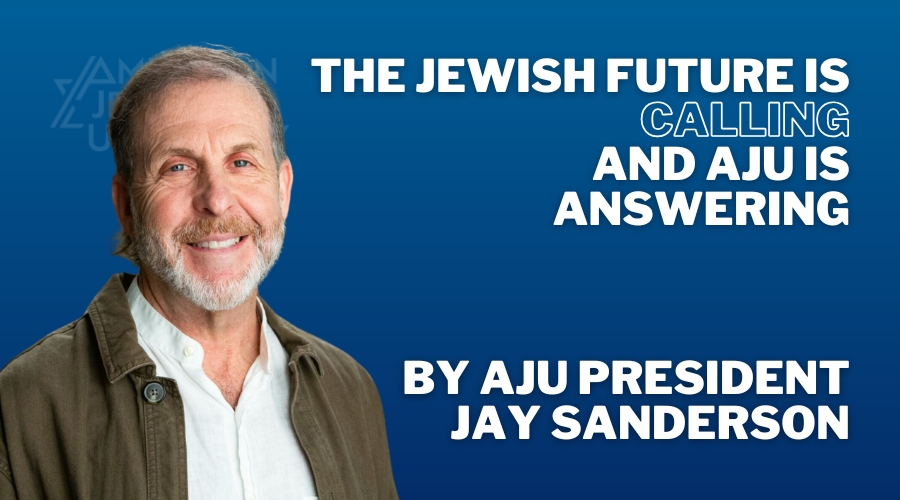
Seven months ago, after a three-year planned hiatus from Jewish communal leadership, I became the president of American Jewish University (AJU) with only one goal: to reimagine and rebuild the foundation of Jewish life in North America. A dear friend and major Jewish leader urged me to be true to myself and my reputation as a disruptor who doesn’t mince words. So here it goes:
The Jewish communal space is facing major challenges we were not prepared for, and it’s clear that we are investing many of our resources on the present at the expense of the future.
For starters, the Jewish community has a leadership pipeline challenge. It’s clear it needs leaders who have a different set of skills and experiences than leaders from previous generations. We need Jewish professionals who are ready, willing and able to address the challenges of today and have the capability to address the challenges yet to come.
The Jewish world also has an engagement crisis. The next generation of Jews identify differently than their parents and grandparents did, and we need to meet them where they are and listen to how they’re thinking about their own Jewish journeys. That means creating entry-points and pathways that will do more than engage them — they will deepen their commitment to the Jewish community and strengthen their Jewish identities.
Finally, we need to collectively change how we envision the Jewish tent; in fact, we have to redefine the very concept of the Jewish tent. We’re at a moment in time where we have to talk and listen to every member of our community in order to move forward. That might make us uneasy, but we aren’t big or strong enough to consciously leave people behind.
We need programs that recognize that the Jewish community of today is not yet equipped to tackle the challenges facing the Jewish world of tomorrow. That’s where AJU comes in.
AJU is an institution with a rich history inspired by two giants: Mordecai Kaplan and Shlomo Bardin. These two shared a commitment to reimagination, creativity and communal transformation, and AJU is leaning into those roots to propel ourselves and the community forward.
We are embracing a hybrid model as both a university of higher education and a living laboratory where Jewish wisdom meets innovation, and experiential education connects timeless tradition with the world we’re shaping today. As a living laboratory, we are bringing together the most influential and thoughtful leaders, thinkers, creators, practitioners and philanthropists to turn bold ideas into action for the future of Jewish life in North America.
AJU transformed Jewish learning when it launched the first intensive class for interfaith couples and individuals exploring conversion, helping countless people build Jewish homes and families. Today, we’re expanding that vision, creating more welcoming pathways for anyone Jewish, Jew-ish and Jew-curious and nurturing the earliest steps of every Jewish journey.
We are launching an innovative approach to graduate school education for educators and professionals with learning being done online, in the classroom and, for the first time, in-residence. Our 2,700-acre Brandeis-Bardin campus in Simi Valley will host weekend-long retreats where Jewish professionals from across the country–staff from Hillels, seminaries, synagogues, camps and JCCs–come together around Shabbat tables, get to know one another and learn from each other in experiential and educational settings.
We’re also announcing the 2050 Institute, which will be the guiding force leading AJU into the future and position AJU as the Jewish world’s leader focused on our most significant challenges and opportunities.
Additionally, we are going back to in-person learning in our Maas Center for Jewish Journeys, which went 90% online during the pandemic. Online education and online engagement, which grew exponentially during COVID, have value and impact, but it minimizes the power of being together. A major value-added of our program has been connecting interfaith couples and individuals learning about Judaism to each other so they can build peer groups that continue beyond the class. That can best be achieved through in-person learning. So, complementing a program that’s almost entirely online, we will be launching in-person classes beginning in four cities: Los Angeles, Chicago, New York City and Miami.
And our ambitions are global. We already offer our Miller “Intro to Judaism” class in Spanish, and our online classes are reaching students in Canada, the Philippines and Mexico, among other countries. We will continue to grow our international presence.
Finally, we are reimagining our Ziering Brandeis Camp Institute and returning it to its roots by focusing on this new generation of young college-aged young people and inspiring them to love Judaism and Israel through experiential learning with an emphasis on arts and culture and text study in the one setting in America that feels like Israel. At a moment when many young people are not traveling to Israel, we will be connecting them in a place that feels emotionally and spiritually connected, our Brandeis-Bardin Campus.
We are singularly focused on the Jewish future. This is not just a new catch phrase; it is our mission. We are devoting ourselves to our own reimagination process, to disrupting the Jewish communal world and to identifying, inspiring and educating our next generation of leaders capable of dreaming about a rich, meaningful, open and engaging Jewish future with innovative and engaging pathways to learning and living Jewishly. We’re building a Jewish future where Jews, no matter where they live or how they self-define, can find a place inside a reimagined Jewish community, one where every voice has value and everyone is contributing to the Jewish future.
Together, we can build a Judaism that is expansive, joyful and deeply rooted.
Jay Sanderson is the president of American Jewish University.
Contact Communications
Michelle Starkman, M.A., MBA
Vice President, Communications
michelle.starkman aju.edu
(310) 440-1526