
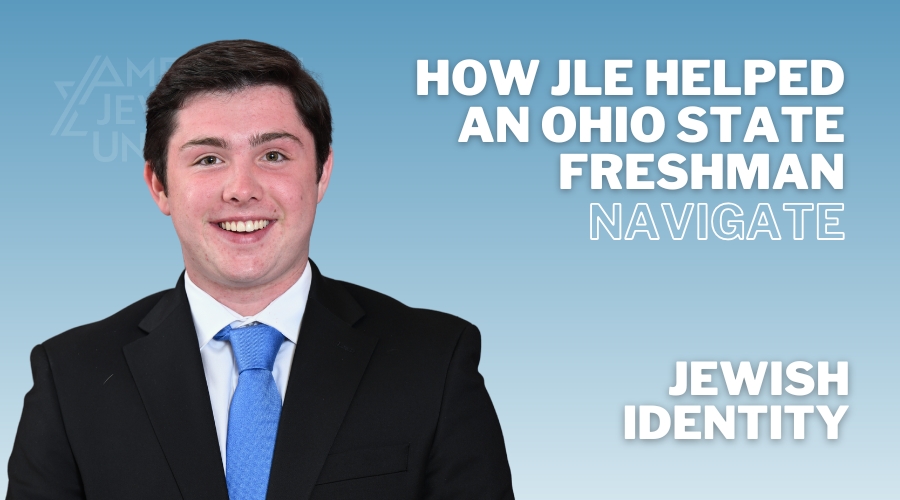
Matthew Devaney, 19, arrived at Ohio State University this fall already moving with the confidence of an upperclassman. A freshman majoring in public affairs with a specialization in nonprofit management—and minors in Hebrew and business—he is deeply involved in campus Jewish life, from OSU Hillel to pro-Israel student organizations. That sense of purpose, he says, was shaped long before he set foot in Columbus, beginning with a college-credit course he took as a high school junior through American Jewish University’s Jewish Learning Experience (JLE).
Growing up in West Bloomfield, Michigan, Devaney attended a large public high school, which was predominately comprised of Christian, Chaldean and African American students.
But “I wore my [Jewish] star proudly in school,” he said. “Judaism is a big part of my identity, and I wasn’t going to hide that.”
As a high schooler, Devaney was active in BBYO, involved in his Reform synagogue, Temple Israel, and participated in multiple Israel-focused programs, including BBYO’s Global Israel Fellowship and International Kallah. Still, he felt there were gaps in his understanding—particularly around history, culture and the deeper complexities of Israel.
That changed when Temple Israel offered JLE’s “Introduction to the History, Culture and People of Israel,” an in-person course taught by Temple Israel Rabbis Josh Bennett and Ariana Gordon, with academic oversight from AJU’s director of undergraduate initiatives, Rabbi Carrie Vogel. The class met weekly and counted for college credit.
“It was extremely engaging, because we got to interact with the rabbis that taught us a very niche curriculum tailored towards learning about Israel, whether you have experience with the subject or not,” Devaney said.
For Devaney, who already came in with significant Israel exposure, JLE “really filled in the gaps.” The course went beyond headlines and talking points, grounding students in history while encouraging dialogue and reflection.
“JLE really got me to explore it at a deeper level, with classmates, with my rabbis, and have deeper conversations about the Israeli-Palestinian conflict, which you wouldn’t normally have,” he said.
Those conversations took on even greater weight in the aftermath of October 7, 2023, the Hamas-led attack against Israel. Devaney took the JLE course in 2024, when the war was still dominating news and discourse on campuses nationwide. “It made the content all the more real,” he said. “The war was still very much going on, and it became a very big talking point in America.”
One of the most impactful moments came through his final presentation, which focused on generational trauma and its role in shaping the conflict.
“This course opened my eyes to the fact that the Palestinian narrative is legitimate, and they've experienced a lot of trauma as well,” he said. “It's healthy that I was able to consider the other side, and that's what JLE pushed me to do—recognize that there’s another side in this conflict and get me thinking about, ‘How do we move forward?’”
But just as important was the academic rigor. JLE introduced Devaney to college-level writing and structured reflection. “Every time you wrote about what you learned in the class and connected it to your readings, you would then have to say, ‘Wow does this relate to me personally? What does this mean to me?’” he said. “That introspective reflection was super important.”
Now, as a public affairs major at Ohio State, he finds those critical thinking skills central to his coursework.
The benefits of JLE were not only intellectual but practical. When Devaney arrived at Ohio State, the AJU course transferred as three college credits and ultimately counted toward his Hebrew minor.
That academic head start has freed him to dive deeper into campus leadership. Devaney recently completed a development internship with OSU Hillel, helping with fundraising campaigns and student engagement, and is now starting as a university ambassador, giving campus tours to prospective students. Hillel, he noted, is “very, very big, very active” on his campus, engaging roughly 3,000 undergraduates.
In the wake of October 7, Devaney also felt what he described as a responsibility to combat any anti-Israel or antisemitic rhetoric. And JLE, he said, helped with that.
“I figured that the most important thing I could do for myself was to educate myself on the topic, so that when I’m approached, I’m able to give a well-educated answer” he said. “Because knowledge is power in this situation.” Today, he is active in Students Supporting Israel, serves as legislative director of Buckeye PAC, an on-campus chapter of AIPAC, allowing him to get involved in pro-Israel advocacy efforts.
“JLE was sort of my spring start for that,” he said.
His engagement extends beyond campus. Devaney is now teaching sixth grade at Temple Israel Columbus, developing his own curriculum called “Judaism in Real Life.” His goal, he explained, is to help students see Judaism as something that extends beyond the classroom. “Judaism can be a guide to your decision-making and life,” he said.
Looking ahead, Devaney is preparing for his first trip to Israel through Birthright this winter. By then, he hopes his Hebrew studies will allow him to fully embrace that time abroad. He traces that passion for Israel back to JLE.
“JLE sort of sparked my interest in Israel,” he said. “Now, after years of Israel education and starting to learn Hebrew, I hope to be able to fully immerse myself in the experience.”
If you are interested in learning more about JLE, contact jle [at] aju.edu (jle[at]aju[dot]edu).
Contact Communications
Michelle Starkman, M.A., MBA
Vice President, Communications
michelle.starkman aju.edu
(310) 440-1526